

- Jinnistan
- Administrator
 Offline
Re: Recently Seen

Comparing this remake to its 2003 Korean original, Save the Green Planet, is a useful metric for how devolved our post-social media culture's grasp on reality has gotten. Back then, Save the Green Planet was a surreal mindfuck comedy. But now, after the various mind viruses associated with Qanon or Covid, the essentially identical plot is disturbingly relevant and relatable, and sits alongside Eddington as this year's most damning indictments of our current conspiratorial confusion.
The short take of the plot is that a type-A CEO (Emma Stone) of a large pharmaceutical company is kidnapped by a duo of conspiracy kooks (Jesse Plemons, Aidan Delbis) who believe that she is an alien bent on destroying the planet. Antics ensue. The primary difference between the original film and this is in the tone of humor, with the original being much more fun and outrageous. This remake isn't so much devoid of humor, but it's set in Yorgos Lanthimos' particular style of humor, which tends to be more cerebral and despairing, which also happens to accentuate the fact that in 20 years, the material has become uncomfortably more believable and much less of a farce. Lanthimos takes advantage with cute little additions, like not-too-subtle references to incels and flat earth theories. Are "aliens" anymore absurd than lizard people? People believed in lizard people running the world back in 2003 too, but they just weren't as vocal about being censored when no one took them seriously. Back then, people who believed in plots of pharmaceutical genetic modification didn't have a cohort running the nation's Health and Human Services. (Whether intentional or not, it was also cute to cast Alicia Silverstone, a vocal anti-vaxxer, in a minor role.)
Lanthimos' callous misanthropy is par for the course here. His oppressively controlled filmmaking is equally amusing and distressing. Emma Stone cannily excels by leaning into the aspects of her on-screen persona which I usually find the least appealing. Will Tracy's script is a weak spot though. He's no stranger to snarky and obnoxiously obvious nihilism (The Menu), and where the original film revels in its absurdity, it seems that Tracy just might be dumb enough to believe all of it.
8/10
This is a lot more sentimental than I would normally expect from the otherwise sardonic Noah Baumbach, but maybe he's just getting older, or maybe he understands that this type of sentimentality is just the right touch for a tribute to one of the last true remaining Hollywood stars who still commands that old-school silver screen glamour. Because this is essentially George Clooney's film, not autobiographical by any means, but he inhabits the script of an elder celebrity actor - the kind of actor who is best at simply being their charismatic self - who has a late-life crisis over his personal and professional regrets with such a committed vigor which both winks at the audience and refuses to fully reveal his hand, where even his sincerity plays like an internalized performance. This disciplined distance is not a flaw here, but the point. The problem is that the film, like most Netflix productions it seems, is way overlong.
7.5/10

- crumbsroom
- Moderator
Offline

Re: Recently Seen
I watched a 90's Godard Woe Is Me that is the only movie of his I've seen post Weekend that feels almost a part of his 60's work I like the most. I admittedly found the first half hour almost impenetrable, but once it gains a focus, specifically on the spectre of Gerard Depardieu possessed by the spirit of an Alphaville-voiced God trying to seduce his wife, I was completely on board. Yes, it's cloyingly pretentious, but it's also funny and unpredictable and poetic and annoying in both good and bad ways. Basically all the stuff that I feel is the director's (long lost) signature move.
I liked it.
- Jinnistan
- Administrator
Offline
Re: Recently Seen
crumbsroom wrote:
I watched a 90's Godard Woe Is Me
Have not seen that one.
- •
 Thread Starter
- Jinnistan
- Administrator
Offline
Re: Recently Seen
Coming across some of the comments made by Bugonia writer, Will Tracy, apparently endorsed by director Yorgos Lanthimos, which are of the opinion that the film has a "happy ending" which is "optimistic", I'm going to have to pretty severely chop down my initial review. Maybe a 6/10, at my most generous.
My explanation involves a lot of spoilers.
- •
Thread Starter- Jinnistan
- Administrator
Offline
Re: Recently Seen
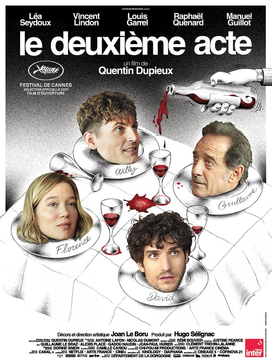
Quentin Dupieux may be our finest surrealist cinema auteur currently working, and part of this success (artistic if not always commercial or critical) is the combined silly humor and audacity, using his surrealism more for taking the piss rather than making a grand ontological statement. His films tend to split between studies of supremely silly idiocy (Mandibles, Incredible But True) and more seriously sociopathic idiocy (Deerskin, Yannick), and his most recent pair of films fall into these respective categories.
The Second Act is an almost Godardian deconstruction of some little indie drama (we never really get past the most surface sense of what it's about), apparently being directed by some futuristic A.I. program, and whose cast members alternate between bitching and boredom, breaking all of the fourth walls and indulging in their own petty vanities. It isn't really any deeper than that, and it is very funny.
7.5/10
On the more sociopathic side of the spectrum, The Piano Accident (a title already fraught with peril) involves a now-adult woman (Adele Exarchopoulos) who became an internet star as a child making viral videos based on her self-immolation. She has a neurological condition that renders her unable to feel pain, so, outside of her online videos of increasingly creative self-harm (which she considers her "art"), she has a habit of inflicting pain on those around her instead. The humor here is much darker but still sharp as a shiv, and does have something of a more substantial cultural comment on the pathology surrounding viral celebrity.
8/10
- •
Thread Starter- Rock
- Moderator
Offline

Re: Recently Seen
How did you watch Villain?
I am not above abusing mod powers for my own amusement.
- Jinnistan
- Administrator
Offline
Re: Recently Seen
How did you watch Villain?
Over the Thanksgiving holiday, spending the weekend at my grandparents, using their cable service, Villain was available on-demand from Turner Classic Movies.
- •
Thread Starter- Jinnistan
- Administrator
Offline
Re: Recently Seen

The parallels to Jennifer Lawrence's previous Mother! is unavoidable, but not really helpful. This is also a treatise on a mother who is irrationally unapprecitated by an aloof and insensitive husband, who goes unacknowledged by her social interactions beyond her isloated setting of a house in the country. The main difference between the two films is that there's nothing here involving any larger political comment. But it still feels as if director Lynne Ramsay, adapting the novel, was taking the opportunity to do her own distinct version of Mother! without Aronofsky's more abstract interests, where Lawrence can do her own unhinged maternity based on the perverse, if common, phenomenon of those men who lose their attraction for their wives as soon as they become mothers. Ramsay, despite some impressively invocative camerawork throughout, still seems unfortunately overly influenced by von Trier, especially AntiChrist, and the film ultimately suffers from similar pretensions, But like Mother!, both films could be defined by their climatic flames.
8.5/10
Oz Perkins is threating to fall into that particular Ti West trap of a modern horror director who excels at sensual atmospherics but who flails at certain plot contrivances. This film falls somewhere between his more suspense-driven horror which he is best suited and the more genre-aware trope-mishmash which he has fallen into, with better results, in his recent studio work. This film is hardly a waste of talent, it's quite good respective of modern horror films, but it's minor compared to Perkins' evident best. He seems prolific, so hopefully he's got better stuff in the barrel waiting.
7/10
- •
Thread Starter- Jinnistan
- Administrator
Offline
Re: Recently Seen

"In the daytime, ghosts are just rumors."
In the unfortunate wake of Rob Reiner, I chose to expedite this viewing, his unintentional swan song. I can't stand the reviews I've seen which lead with some variation of "not nearly as clever..." No shit, assholes. Lightning don't grow in bottles. That's the kind of criticism I would expect from this film's funniest new character, Simon Howler (clearly based on real-life bitchbag Simon Cowell), exactly the kind of entertainment industry cog-todger who thinks real artistic appreciation is an illusion to be exploited. The kind of tit-twiddler who's always offering asinine advice to make himself seem in control of the situation.
The best we could have hoped for a film like this, a long-gestating 40-year-late sequel to a cult classic, is that it offers some warm character nostalgia and some clever callbacks. That would be par for the course. And this film certainly has plenty of both. But in addition, it extends its rockumentary satire to the Beatle Anthology "reunion", where, there's still plenty of instances of passive-aggressive bickering between these old men who, once upon a time, spent way too much time with each other. There's also a warmth to this, in our recognition of it, and that this just happened to be the scene where Paul McCartney decided to make a cameo (not being "bossy" but making the kind of suggestions which easily eclipses Tap's own abilities) makes it all that much funnier.
But maybe the film is absolutely at its best when it's just being silly, like the nonsensical non sequitur above quote, or "Hell Toupee" which might the stupidest thing that's made me laugh this year, or the the film's sudden glorious anticlimax which subverts any further unnecessary sentiment. "Fuck you, Spinal Tap".
7.5/10
Here's a good example of low expectations paying off some impressive dividends. My interest in this umpteenth 80s remake was limited to the involvement of writer/director Edgar Wright (for whom I still have some goodwill) and a more morbid curiosity to hate-watch how badly Paramount (so recently in the news of late) would fumble and contradict the original source material for their own tech-lord agenda.
Imagine my delight. Certainly, popping off with Sly's "Underdog" is definitely a helpful ingredient to secure my optimism for a little while, at least, but what was most surprising, even shocking, was in just how rigidly faithful Wright and co-writer Michael Bacall chose to adhere their screenplay to the original novel. They must have been as struck by how relevant and culturally prescient Stephen King's 50-year-old manuscript turned out to be without very many tweeks. The original book was set in 2025 - m'k? - "in which the nation's economy is in ruins and world violence is rising". This film wryly doesn't even bother mentioning the year in which it takes place. Obviously certain technological advancements - involving drones, GPS, artificial intelligence deepfakes - are used to fill in some of the then-sci-fi concepts. But it's remarkable, for example, how much of our contemporary 2025 primetime TV looks like King's dystopian entertainment, overrun as it is by reality shows, game shows and, um, reality game shows. Oh, and plenty of cop-aganda. (NCIS, like ICE, is operating in a dozen of our urban markets.)
But let's focus on King's dystopian intentions for this setting. What does this mass-media landscape reflect about its social and cultural conditions? Where corporation and government have become indistinguishable in an oligarchic authoriatarian technocratic state, with wide and disproportionate wealth inequality, where the public which overwhelmingly consisting of working class have-nots are placated and pacified by an entertainment regimen which exploits greed, insecurities of social hierarchy and encourages the erosion of empathy. Note the hero here, Ben Richards, and how his empathetic instincts are precisely what makes him an untrustworthy outcast in the value system enforced by this technocracy.. This vision of King's in which he predicted a future "pop" culture of 2025 is straight up eerie, and the fact that it rings more true the more faithful this new film sticks with the original novel should be its most alarming attribute.
Unfortunately, I think that these, eerie but accurate, aspects may be why the film has seen such a tepid reaction, both commercial and critical. Not that there's necessarily a conspiracy here (despite the delicious urge to make a Ellison/'Killian' analogy), but that popular audiences themselves are likely just as disturbed and uncomfortable by the fact that they. too, are being largely indicted here, especially audiences of more affluent means (aka, the critic class), for so vapidly consuming these value systems being currently disseminated by our own tech-media oligarchy. Our own current addictions to status-envy and distractions which fuel this dehumanizing consumerism. Because this entertainment template is not simply limited to primetime television (it is only more grossly concentrated there), but is also clearly evident in our social obsessions with the "virality" of online influencers, which is equally based on exploiting our wealth and status insecurities.
Besides all of this, I'm still hesitent to go all-in on praising the film. It is an impressive action/sci-fi genre effort, and Wright has proven himself expert at pacing and excitement. Wright also seems to preserve some Verhoeven-esque flavor to its satirical edge. Glenn Powell, perhaps, might be miscast, as he exudes such a transparently decent profile. Even his anger feels light-hearted. Maybe someone with a shadier face, with more moral ambiguity, could have elevated it from its matinee status. Maybe looking like such standard action B-movie fare is how Wright was able to smuggle in such subversive content to begin with.
Despite how faithful this film is to the original novel, it does finally flinch a bit at the very end, probably due to some...uh, 9/11 stuff. But regardless, and even as this deviation raises some suspension-of-disbelief issues, the end result accomplishes much of the same outcome, and this might ultimately prove just as provocative and subversive as intended. Still, it's interesting that in a year of controversial films about resistance to our current political trajectory (of which One Battle After Another is the frontrunner), I would've expected more controversy from commentators over this film as well. Or maybe it plays better under the radar. For now.
7.5/10
- •
Thread Starter- crumbsroom
- Moderator
Offline
Re: Recently Seen
Where did you watch the Spinal Tap sequel?
For some completely unknown reason I was put off watching it when my father claimed it was apparently no good. Not that my father has ever known shit about what is happening in movies, and I don't even think he's watched the first one beyond what he would walk in on during one of my twenty million viewings.
- Jinnistan
- Administrator
Offline
Re: Recently Seen
Where did you watch the Spinal Tap sequel?
At home. (From a torrented mp4  )
)
For some completely unknown reason I was put off watching it when my father claimed it was apparently no good. Not that my father has ever known shit about what is happening in movies, and I don't even think he's watched the first one beyond what he would walk in on during one of my twenty million viewings.
Due to the number of callbacks, I imagine you have to be familiar with the original in order to appreciate the sequel. Call it "fan service" if you will. But obviously it's not even trying to compete with being as good as the original.
- •
Thread Starter- Jinnistan
- Administrator
Offline
Re: Recently Seen

Richard Linklater had a busy year in 2024, shooting two films, both of which have become festival and award-season highlights in 2025.
Nouvelle Vague is a dramatization of the 1959 filming of Jean-Luc Godard's iconoclastic A bout de souffle (Breathless), not the first film in the vaguely defined French New Wave era (and I suspect that Godard himself would prefer the 'New Vague' pun) - as this film points out, Godard was actually one of the later of the Cahiers du Cinema cache of critics to be able to make a film - it is generally presumed to be the movement's most provocative mission statement. Guillaume Marbeck, playing Godard, inhabits the cool philosophical facade of the legend, veering on parody (as Godard himself frequently did as well). The film offers a delightful array of portraits of the French cinema masters, both New Wave (Truffaut, Chabrol, Rivette, Resnais) and legacy (Cocteau, Bresson, Melville) and the ultimate grandfather of all of the European New Wave movements, Rossellini. Some of these are not particularly more than cameos (Agnes Varda is given no spoken lines), but for French cinema fan service, it's a lot of fun. More extraordinary is Linklater's excellent emulation of early New Wave cinematography, a salute to fellow participant Raoul Coutard, who lensed many of Godard and Truffaut's early B&W films, Linklater has made a film which is tactiley and fluidly a loving recreation of the era's rhythm and aesthetic.
8.5/10
A fascinating semi-fictionalized - being based on a combination of true events and private letters - account of the night of the opening of the musical Oklahoma! (*exclamation point*), and Lorenz Hart, the former lyricist for Richard Rodgers, lost in an existential malaise over his partner's new work with lyricist Oscar Hammerstein, instinctually hating the new musical, while trying to make nice in the avalanche of critical appraisal. "High schools will be performing it for decades to come", he gushes.
The pure excellence of the film lies in the pitch-perfect script from Robert Kaplow, which examines the intricacies of Lorenz Hart, based on meticulous research, at the end of his short life as he would die from drunken self-negligence within a few months of this film's one night setting, displaying his gregariousness, his gift of gab, his melancholy bouts of self-pity, his well-earned ego even on the precipice of imminent failure, his struggle with his indulgences. Like the most entertaining bar raconteurs, a deeply frustrated romantic. The film is beautifully structured as a real time one-act play, with Hart holding court, regaling and agitating, his charm flaming and fading accordingly.
There's one problem, and it might just be me. I'm not much of a fan of Ethan Hawke, who, on his best films, I find to be overeagerly showy. Now, I don't know that much about the real-life affectations of Lorenz Hart, maybe this is an accurate performance. Hart does seem to also be of the overeagerly showy sort But for me, Hawke comes off more like some kind of parody of John Malkovich doing a Dorf impersonation. For me, despite the excellent scripting and characterization, Hawke is more often than not a distraction and a caricature. This might make more sense in scenes where he's holding court, where Hart is more obviously putting on a false performative face. But in the more intimate scenes with Margaret Qualley, or even with Richard Rodgers, there's too much of a performative affect which rings false to me. Clearly others disagree, as Hawke is being praised and touted as an Oscar contender. I don't know. Maybe Ethan Hawke is the Oklahoma! of middle-brow American actors at the moment. But for me, he needs to curb the exclamation points in his acting.
7.5/10
- •
Thread Starter- Rampop II
- Member
Offline

Re: Recently Seen
For me, despite the excellent scripting and characterization, Hawke is more often than not a distraction and a caricature.
The only exception being Tesla imo, where I thought he was finally good in something, but otherwise a distraction, never bad enough to ruin a movie but always something to be endured in order to enjoy otherwise good movies.
But as Tesla he was actually good.
- Jinnistan
- Administrator
Offline
Re: Recently Seen

Low-budget independent cult comedy, and the sole motion picture from writer/director Nelson Lyon who was a figure in the '60s NYC underground, earning an 'X' on release for what looks now like some pretty mild nudity but heavy with erotic suggestion. Sarah Kennedy, a vivacious Goldie Hawn lookalike, is a hip young New York woman who finds herself aroused and fascinated with an obscene caller and becomes determined to seek him out in real life, leading to a wild set of sexually surreal misadventures. The film is far more art-house than porn though, closer to Robert Downey than Andy Warhol, saturated with a counterculture dopehead humor and sensibility. Largely forgotten until its appearance on DVD (from Vinegar Syndrome) about a decade ago, to much kinder reviews. It's a sexy and silly stylish gem.
8/10
Here's a project which is so legendary that you start to assume that it's simply a legend to begin with (kind of like all of those lo-fi short films screened at places like the Channel One Theater or the Kentucky Fried Theater which have somehow never seen the light of day). In the late '60s, film school student Joe Dante compiled and edited together a massive collection of film detritus of whatever he could find lying around the local archives, including lots of B-movie westerns and sci-fi and horror, old TV shows and commercials (Mighty Mouse is a recurring character here), long-abandoned educational shorts, just literally whatever, and then took the whole damned concoction on the road to screen at colleges and local art-houses for fellow drunk/stoned students and hippies best suited to appreciate the randomness, the serendipitous synchronicities, the pure nostalgic spew of Boomer B&W youth. And Dante did all of it independent as fuck, never paying a dime for the rights to any of it.
Turns out this monstrosity does, in fact, exist and has just been released (also by Vinegar Syndrome) in a 4 1/2 hour cut. Some sources allege a 7 1/2 hour cut exists, but this is probably more than enough for most. As someone who has dabbled for years making similar compilations - either channel-flipping on VHS or splicing incongruent movie scenes, or some bastard bouillabaisse of all of the above - it'd deeply heartening to know that someone, especially a legend like Dante, actually pulled the damn thing off.
It's hard to rate a piece of work like this, as I'm sure viewers' patience will vary, but on sheer sweat equity, it's a 9.5/10.
This one is less difficult to find than the others, and I've always kinda shrugged it off on both its reputation (which is poor) and the semi-bootleg look of it. Much of the poor reputation lies in the fact that the two largest acts involved, Jimi Hendrix and Led Zeppelin, were omitted (Hendrix missed his plane and Zeppelin pulled their segment in a contractual dispute), and I'm still uncertain as to whether the film ever actually had a theatrical run at the time (shot on 1.85:1, it was definitely not originally intended for television).
Now I will admit that it is more my fault that I never bothered to notice the name "Roland Kirk" in small print there at the bottom. That alone would be more than enough to interest me, even besides learning that Kirk also sits in with Clapton, Guy and Bruce for a couple of jams. Clapton, although top billed, only shows up for the last two numbers, but he does have good chemistry with Buddy Guy. Both Guy and Stephen Stills take turns fronting a would-be power trio with Jack Bruce and Buddy Miles on rhythm. And in addition to Rahsaan Roland Kirk, the Modern Jazz Quartet (then on Apple Records) covers the jazz side of the bill. Colosseum, a somewhat overlooked blues-prog outfit that falls somewhere between Soft Machine and early Deep Purple, gets a lion's share of airtime, and they don a powerful drum/bass section as well, but their keyboardist tends to get a little wanky.
I'm also not sure if any of this ever saw a proper release on vinyl, but I'm guessing not. Eventually its poor reputation is not all that well founded, and I imagine most people are just disappointed to find top-billed Clapton to not be in very much of it.
7.5/10
- •
Thread Starter- Rock
- Moderator
Offline
Re: Recently Seen
I remember liking Sarah Kennedy in The Working Girls.
I am not above abusing mod powers for my own amusement.
- Jinnistan
- Administrator
Offline
Re: Recently Seen
I remember liking Sarah Kennedy in The Working Girls.
The thing about Goldie Hawn wasn't a dig. Apparently Kennedy was Hawn's replacement on Laugh In.
In the spirit of The Movie Orgy, I thought I would make available one of my compilation films lying around from a couple of years ago. (approx 995 mb) It's all I got for you for Christmas this year. Cheers.
- •
Thread Starter- Jinnistan
- Administrator
Offline
Re: Recently Seen

It might seem surprising for anyone who can't remember before Community but Chevy Chase was always an asshole. It was never a revelation. Even at the height of his fame in the '80s, people already knew the stories about his fistfight with Bill Murray, his bringing Jane Curtain to tears, getting sued by Cary Grant for making a joke about his sexuality. These things were just as well known as his stints in rehab at the time. I don't want to say that no one cared, exactly, but it was somewhat assumed, expected, tolerated you may say. It was, in fact, his whole public persona, whether in interviews, talk shows or hosting award shows. Chevy's going to talk shit.
To that extent, this doc doesn't really show anything new on this point, other than that, due to his health issues, his shit-talking is a lot less sharp and clever these days. The smarmy charm has faded into crusty spite. But occasionally his quick-wit shows, mostly when he's dealing with anyone who isn't this documentary filmmaker. Whether or not the filmmaker, Marina Zenovich, has less than noble intentions is doubtful, but I can definitely say, quite aside from the subject, that this is formally the weakest of Zenovich's celebrity docs (which include very good to great films on Roman Polanski, Richard Pryor and Robin Williams). It's easy enough to blame that on Chase's hostility, but there are a couple of substantial criticisms in Zenovich's narrative decisions.
The most glaring problem is that, for whatever reason, Zenovich ignores Chase's early biography until dumping it in the third act, like some kind of twist. If anyone knows of any dramatic advantage to this approach, I certainly have not seen any from the reviews. What this effectively accomplishes is to establish Chase, as a young man in college, as a somewhat sociopathic prankster, with no personal or psychological context for his abrasive tendencies. While I was watching, already being familiar with Chase's biography (which Chase himself has been fairly open about discussing), I was ready to call this out as a deliberate cheap shot. If the audience of this documentary was informed of the extent of childhood abuse in the Chase home, from an abusive alcoholic mother, a resentful authoritarian step-father and an absentee father who had little to do with the boy, then the awful logic of Chevy Chase's anger, insecurity and defensive cruelty makes a lot more sense. Eventually, over an hour in, the doc does decide to go into detail about these facts, but too little too late, imo. Instead, we've already had an hour presenting Chase as a selfish sadist.
The other glaring omission, which is never revisited, is Chase's early career as a comedy writer and performer. We do get the stories about Chase's flirtations as a jazz drummer, playing in a proto-Steely Dan, and his musical talent deserves some attention. But then the doc shows Chase as something of a stoned layabout in NYC, with friends pushing him to do something with his life. In fact, during this time, Chase was an accomplished writer for Mad and National Lampoon, and a writer and performer with the Channel One Theater (which would later produce the film The Groove Tube). Even before his breakout role in the Lemmings musical, Chase was a regular writer and performer for both the National Lampoon Radio Hour and the National Lampoon's comedy LPs (of which Lemmings would become the third). It may very well be true that Christopher Guest didn't care for Chevy and made him audition for the role, but it wasn't up to Guest whether to hire him or not, but Tony Hendra, the director of the production. It doesn't really make a lot of sense to have Lorne Michaels explain why he only wanted Chevy Chase as a writer (the head writer, no less) of SNL if Chase was merely, as this doc presents, a well-known slapstick goofball.
Also, it would have been nice to mention Chase's important National Lampoon relationships with Doug Kenney and Michael O'Donaghue, both of whom would be immensely impactful in the coming years. The impact of Kenney's premature death in 1980 on Chevy, who had been with him just days prior, is another baffling omission which could have put context to Chase's increasing self-medication at this time.
Lastly, I think it's pretty clear, and I've stated this opinion before, that it was insulting not to use Chevy Chase for the SNL 50th special. As the show's first bonafide star, who pretty much single-handedly made the "Live from New York" opening iconic. And instead Lorne is going to go with Sabrina Carpenter? Frankly that makes Lorne Michaels look like a much more desperate old man than Chase, the kind of desperate old man who clings like a vampire to youth to suck the relevancy back into his own shriveled ratings potential. That's probably why Michaels looked so sad and lonely on that SNL stage during the final 'goodnights', watching as Chevy Chase is more sincerely embraced between Dave Chappelle and Eddie Murphy, neither one of them doing it for the clout.
Finally, this doc does not earn its sentimentality. This is not like the John Candy doc, it's 180-degrees in terms of the universal affection involved. Maybe Chevy deserves a more sardonic tribute.
7/10
(And this is just a stray note. I have to admit that I was never really interested in real time with all of the Community drama, and, knowing Chase is a bit of an asshole, just assumed that was the issue. But knowing now the facts? WTF? So the writers of Community, because they didn't like Chase, were deliberately trying to write his character into more distasteful situations. They lean heavy into the character's bigotry, basically plagiarizing GOB's Franklin puppet from Arrested Development, by having Chase do a bit with a blackfaced handpuppet. Chevy got pissed and indignantly asked, "Are you going to have me calling someone a nigger eventually?" This was reported in the press as "a meltdown with Chase using the N-word", suggesting the kind of racism which he was actually protesting? Again, you can notch it up to karma - Chevy has been very unfair to lots of people in his career as well - but that's some serious bullshit.)
- •
Thread Starter- Rampop II
- Member
Offline
Re: Recently Seen
Quentin Dupieux may be our finest surrealist cinema auteur currently working, and part of this success (artistic if not always commercial or critical) is the combined silly humor and audacity, using his surrealism more for taking the piss rather than making a grand ontological statement. His films tend to split between studies of supremely silly idiocy (Mandibles, Incredible But True) and more seriously sociopathic idiocy (Deerskin, Yannick), and his most recent pair of films fall into these respective categories.
The Second Act is an almost Godardian deconstruction of some little indie drama (we never really get past the most surface sense of what it's about), apparently being directed by some futuristic A.I. program, and whose cast members alternate between bitching and boredom, breaking all of the fourth walls and indulging in their own petty vanities. It isn't really any deeper than that, and it is very funny.
7.5/10
On the more sociopathic side of the spectrum, The Piano Accident (a title already fraught with peril) involves a now-adult woman (Adele Exarchopoulos) who became an internet star as a child making viral videos based on her self-immolation. She has a neurological condition that renders her unable to feel pain, so, outside of her online videos of increasingly creative self-harm (which she considers her "art"), she has a habit of inflicting pain on those around her instead. The humor here is much darker but still sharp as a shiv, and does have something of a more substantial cultural comment on the pathology surrounding viral celebrity.
8/10
Having finally had the good fortune to see both of these, I'm hoping we don't have to worry about Quentin's well-being. I can't help sensing that these latest films hint at a cry for help. Incredible but True tackled midlife crisis, Daaaaalí the shadow of one's own mortality, and now two back–to–back tragedies depict people with careers in film/video production tormented by the question of whether there is any real value in their work at all. Call me a worrywart, but you never know with these artistic types, what demons may haunt them.
- Jinnistan
- Administrator
Offline
Re: Recently Seen
I wouldn't call The Second Act a tragedy exactly and many of the "torments" are eventually subverted - you never know where the script ends and the personal testimony begins but most of the latter is undermined in later scenes.
I also recently saw a hot take from someone who claimed that One Battle After Another isn't really political but "a metaphor for Paul Thomas Anderson reaching the end of his directing career". Not sure how the "Christmas Adventurers" plays into the latter, but otherwise I think that's nonsense anyway. PTA is only 55, folks. Unless he decides to retire like Tarantino (which doesn't seem likely to me), his career is far from the end.
- •
Thread StarterA lot of people don't realize what's really going on. They view life as a bunch of unconnected incidents and things. They don't realize that there's this lattice of coincidence that lays on top of everything. Give you an example; show you what I mean: suppose you're thinking about a plate of shrimp. Suddenly someone'll say, like, plate, or shrimp, or plate o' shrimp out of the blue, no explanation. No point in looking for one, either. It's all part of a cosmic unconciousness.
Everybody's into weirdness right here.