

- crumbsroom
- Moderator
 Offline
Re: Recently Seen
Have I talked about Eephus? Has anyone else seen it? I didn't know what I thought of it while I watched it, but it is a movie that just lingers.
Baseball is the best sport to make movies about.
- Jinnistan
- Administrator
Offline

Re: Recently Seen
crumbsroom wrote:
Baseball is the best sport to make movies about.
Oh, I see. As soon as the Blue Jays are tied for the lead with the Yankees, all of the true colors spill out.

- •
 Thread Starter
- Jinnistan
- Administrator
Offline
Re: Recently Seen
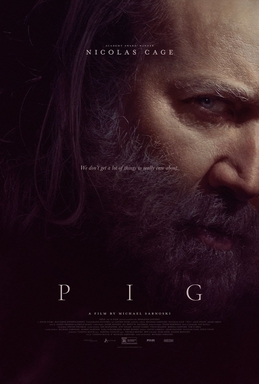
Generally regarded as one of if not the best of the recent spate of Nicaissance Cage films. I found it to be more indicative of what I like least about these so-called comeback performances. This isn't self-parody, necessarily (he's already accomplished an entire genre of that), but in all honesty the bulk of his performance here rests on the simple fact of being Nicolas Cage, albeit a more exhausted version, but with an unmistakably intense brood. Cage simply has to look like himself, anguished and eccentric and vaguely confused, to establish his character, and the audience's preconceptions of Cage handles the rest. That he's a hermit truffle-hunter on the hunt for his stolen pig also establishes a built-in pathos, and thankfully the film is sincere enough to avoid smirking camp, although this earnestness also makes the film a bit dismal. But this isn't a bad film at all, even as a contrived revenge drama. I just wouldn't consider it, as Cage does and many critics do, a career best.
7.5/10
The upside to writing and directing your own vanity comedy films is not only can you pay a couple of gorgeous actresses to be contractually obligated to find your schlubby hubby body sexually irresistble but you can also afford phallic prosthetics as well. What you don't have to worry about, apparently, is bothering to write any jokes for your vanity comedy film. Instead, you can rely on some (schlubby) slapstick and grabass, some sitcom-cutesy banter and one admittedly amusing homoerotic fistfight. I guess that's enough in this economy.
6/10
This is one of those hysterically stupid scripts which must have been written with the "second screen" ethos in mind. Either that or Ron Howard and his writer, Noah Pink, have just lost any remaining respect for their audiences. Based on true events, allegedly, I have not seen but have no trouble recommending the documentary The Galapagos Affair: Satan Came to Eden instead. (The fact they truncated that awesome subtitle is evidence of the total lack of imagination utilized here.)
There are nowhere nearly enough tsunamis in the Pacific Ocean to wash the stench of this putrid motion picture off of the servers of whichever forsaken streaming service it will be damned to fester.
1/10
- •
Thread Starter- Jinnistan
- Administrator
Offline
Re: Recently Seen

There is some dislocation involved in adapting Thomas Pynchon's Vineland, and subsequently one of this film's biggest surprises is in how little of an adaptation it turns out to be. Given the shifting chronology, audiences will have to accept a fictitious alternate 21st-century America which had a militant left-wing revolutionary network operating roughly around the time of the Obama years. It might just be easier to assume this film as entirely "near future", as the extremities of the political polarization, between social justice warriors on one side and anti-immigrant, um, Christmas nationalists on the other, is eeriely more prescient for our current moment than events some 16 years in the past. But in this way, the film's two time tracks, separated by approximately a generation, seem to both overlap with our current social climate, and if you can shrug off this inconvenient anachronism it doesn't really alter or diminish any of the more pointed commentary on our current day and age. Whether or not this will be seen as the best film of 2025, and it's surely a candidate, what's less contested is that this is the most 2025 film, and as great films should, it will be seen as a touchstone of the mood and tenor of this era.
Setting the historical incongruities aside, and simply enjoying the film as a tale, it is still a marvelous work. All of the specifically American idiosyncrasies, the dogmas and the violence, are caricatured and sawed-off and largely rendered tragically absurd, a message for the youth (epitomized in an excellent debut performance from Chase Infiniti - her real name, I'm told) to avoid the "bullshit", the sins and pretenses of the past, a truly progressive incitement. Our little Leo DiCaprio, has finally gotten as close as he can to summoning his inner Jack Nicholson. And the most intense car chase sequence which doesn't even require a single turn of the steering wheels. So much triumph.
And between this and Phoenician Scheme, Benicio del Toro better get his goddamn Oscar this year. Who are we fooling, folks?
- •
Thread Starter- Jinnistan
- Administrator
Offline
Re: Recently Seen

Overwrought direction, overemotional performances and an unconvincing underwritten script renders the dissonant ambiguity of King's book into typical millenial trauma porn.
5/10
- •
Thread Starter- Jinnistan
- Administrator
Offline
Re: Recently Seen

This seems like a very medicore effort from someone, Aronofsky, known for some pretty visionary work (Requiem For A Dream, The Fountain, Black Swan, Mother!). The thrills are such cliches as the NYC confluence of ethnic syndicates (the tagline in the poster speaks for itself) or the post-John Wick trope of putting people's pets in danger, and, for safe measure, a handful of gratuitous stunt castings (the best being an unrecognizable Griffin Dunne), all intended to be vaguely familiar, lazily edgy, mildly amusing, but pretty forgettable. This is Aronofsky cosplaying a low-grade Safdie Bros film while Austin Butler cosplays a low-grade Johnny Depp jabroni.
7/10
- •
Thread Starter- Jinnistan
- Administrator
Offline
Re: Recently Seen

As I've pointed out before, I find the modern type of 'talking head' documentary far more bearable when it limits its heads to those who actually knew, worked with and had direct personal affection for the doc's subject, and admirably this doc succeeds in focusing the commentary mostly on family and collaborators. And given Candy's transparent grace, gregariousness and personal generosity, it's equally excusable that this doc frequently dips into open sentimentality. John Candy had a distinct sentimental warmth which exudes from his sensitive, childish eyes both on screen and off, and the true-life man we see in his home movies, family photos and even his remarkably unguarded interviews confirm the sincerity of the warmth with which audiences intuitively related. The film offers no great revelation about the fact that Candy was almost uniformly adored and trusted by everyone in his immediate proximity.
So the revelations instead focus on what was more implicit in his tender nature. It isn't difficult to see how issues regarding his weight and health were constant factors of insecurity and embarrassment, but that's ultimately superficial. For example, it would be easy enough to say that Candy's premature demise - from a heart attack at 43 - was a direct result of his lifestyle choices, but it doesn't begin to answer the questions of why he made such choices to begin with. Learning that Candy's father had a similar, and sudden, heart attack, at 35, puts the proper genetics in context. (Candy's older brother would also have a heart attack at a young age, although luckily he would survive.) The fact that Candy's father's sudden death would occur on the morning of John Candy's 5th birthday is simply shocking, but not quite as much as the fact that the family insisted on carrying on with the birthday party, and would subsequently, over the years, refuse to discuss or broach the subject. John Candy developed a monster guilt complex from this trauma, and this was the disease for which he self-medicated with food and drink and smoke, and which inspired his almost desperate need to please people. Candy would mostly keep this secret trauma to himself, abscessing into anxiety attacks as well as a terrific fear of the inevitability of his own mortality. This fear and guilt, properly understood, becomes evident in Candy's eyes throughout his life, and forms the emotional power of the pathos in his best performances. Like Del Griffith, Candy's signature creation, and the lonely way he stutters the iconic line, "I li...I like me."
It would be easy, cheap even, to fault this documentary for being a bit corny. John Candy was beautifully corny. And he was, as he said, "an easy target". The cruelest part of the doc involves a number of completely insensitive showbiz-type interviews. Not all of the interview material was so insensitive, but enough. Where interviewers would press Candy on his weight, long after his eyes have made it clear that he's hurt by the topic. Questioning his judgment for taking on film roles which he clearly did as favors to those he didn't want to disappoint. But one aspect mentioned in the doc which is worth noting is that in spite of Candy's physical dimension - which never really needed any further elaboration - John Candy would never resort to using his girth as a punchline. And the only time he did, in Stripes' mud wrestling scene, he hated himself for it.
One other stray observation: although, among Candy's closest friends, Rick Moranis' absence in the doc is conspicuous, I have little doubt that Moranis' retirement from the entertainment business was a direct result of John Candy's death. Some things don't need to be stated out loud.
8.5/10
- •
Thread Starter- Jinnistan
- Administrator
Offline
Re: Recently Seen
Much of my contrarianism, despite what it may seem, happens to be completely involuntary. I don't know why. I'm inclined to blame the more arbitrary fickleness of critics, especially those who are more committed to pop cultural relevance than artistic quality. Pop culture, by definition, is as fickle as the weather and, as an arbiter of cultural significance (outside of sheer nostalgia), tends to be wildy inaccurate. But FOMO keeps those with insecure discernment constantly focused on the sizzle and the flash, rather than the steak in the pan. That those who most venerate pop culture are also fully committed to encouraging more erosive attention spans is probably not a coincidence.
Which is why it seems, to me, that many critics who were unimpressed with the latest John Candy doc must have spent the entire film staring at their phones rather than watching the damn thing. Hey, maybe I'm wrong. Maybe they're just stupid. I'll give them the benefit of the doubt by suggesting that they're distraction addicts instead. In any case, let me illustrate a number of critical inconsistencies in their reviews to make my case.
As I've long railed against the 'talking head' style of documentary, which has been the dominant documentary form for over a decade now, it wasn't lost on me that most film and TV critics were eagerly lapping them up, no crumbs, this whole time. Hence my contrarian nature, per se. But in those certain rare instances when a talking-head-template doc manages to keep its participants somewhat relevant to its subject - as opposed to bringing in a variety of 'pop culture scholars', or a small army of readily available C-list quasi-celebrities, or even some rando everypeople off the street to blandly reminisce and basically anything else to make the doc look more and more like a bad VH1 special - and I actually manage to find something insightful and illuminating and even emotionally engaging about the subject under discussion, these rare documentaries tend to be exactly the ones which conversely get short-changed by the same critics so enamored with the typical Netflix-style time-wasters. Maybe, it could be, people are just slowly recognizing what I've been seeing all along. Maybe such sharp satire, such as The Onion's recent Bad Pedophile, has made the fans of this same template of documentary, which has been so saturated in the culture for many years, slowly open their eyes to the utter artifice and inconsequentiality of the form. But unfortunately, like all babes with newly opened eyes, they remain unable to discern the real from the artifice. Like someone newly introduced to the fact of historical conspiracy, unable to judge whether Paul is dead or not.
I'll focus primarially on this awful AV Club review because it's an easy epitome of the problem, but I will briefly note this one take from someone over at RogerEbert's site who complains that "little to no interest is paid to Candy's considerable growth as an actor over the course of his career - particularly in the last few years of his life." I'd argue that this critic paid little to no interest in watching the documentary closely, because the doc does indeed include a number of Candy's acting highlights, even finding his ability to bring a touching pathos to films like Splash and Summer Rental and The Great Outdoors, where such pathos was completely unnecessary to these slapstick-oriented roles, and with a special focus on his work with teens and children, culminating in his benchmark Uncle Buck (not a great movie, btw, but greatly elevated by John Candy). And, obviously enough, a substantial amount of time is spent simply on Planes Trains and Automobiles alone, Candy's finest acting accomplishment. And "particularly in the last few years of his life" is simply perverse, as John Candy did not have great screen success in these years (middling fare like Harry Crumb, Speed Zone, Nothing But Trouble, Only the Lonely, Delirious and the exceptionally unfunny posthumous Wagons East), but maybe this critic took special umbrage that the doc excludes a celebration of Cool Runnings (which, presumably, would be this critic's nostalgia overcoming their faculties). But what this doc does show is how this late-career success was a burden on John Candy, who spent these years terribly concerned about his continuing professional viability.
Now for this AV Cunt. Idiocy amok. "John Candy: I Like Me doesn’t contain anything even remotely troubling about the Canadian comedy legend." Oh really? I suppose this twerp is strictly defining "troubling" in the "pop cultural feeling" of something potentially cancelable. So, no, in this strictest sense, the doc doesn't reveal any bad behavior on Candy's part. But what's more troubling is the revelation of John Candy's personal trauma, to which this critic seems casually callous. "In fact, it doesn’t contain much at all aside from praise. Candy’s relatives, childhood pals, and famous comedy coworkers line up to glowingly reminisce about the actor." Oh really? None of these "relatives" especially had anything to say about their worries over Candy's self-destructive consumption, or the anxiety-inducing root of these compulsions? Staring at his goddamn phone the whole time.
This set-up is appropriate: Aside from a basic biography and the kinds of personal details so broad as to be perfectly impersonal (His family home was filled with food and laughter? He had to make the hard choice to pursue performing instead of working a typical nine-to-five?), the documentary has little interest in psychological insight or the mechanisms of Candy’s approach to his work. It’s only worried about his legacy as a kind man and a good dad.
Such "broad", "perfectly impersonal" details like.....his father unexpectedly keeling over from a widowmaker heart attack on the morning of John's 5th birthday?!? And the family making John go through the joyous motions of a birthday party in spite of this? And the repression by his family to never discuss the event again?!? ("Filled with Food and Laughter!!!") Yeah right. No insight whatsoever in how this childhood trauma which Candy had to keep closely clenched to his secret heart had any kind of bearing on Candy's "mechanisms". What a fucking asshole.
"Sure, it’s mentioned that Candy’s own father died young..." Oh, is that when you happened to look up from your phone, you cuntbagged son of a bitch? Oh, sure! Whateves!!! "[T]his looming hereditary threat is skirted over just like the miniature histories of Second City, SCTV, and a stacked Toronto production of Godspell...." Fwtw, John Candy did not take part in the Toronto production of Godspell, so there's absolutely no reason at all to have spent more time on it than this doc does. And the rest of that is just pure lies, or negligence. There's a large chuck of the first half of the doc dedicated to both the onstage Second City performances, and backstage camaraderie, and to the SCTV production. Meanwhile the "looming hereditary threat" is a palpable subcurrent to the entire documentary, but especially and explicitly so while covering his final years. Overlooking this obvious fact, this critic offers a more glib analysis: "the doc alternatively blames his weight for his failing health and shames interviewers for drawing any attention to it". I think the latter had more to do with the shamefully mocking manner in which these interviewers broached the subject. And also, in case you missed it, the doc spends at least as much time blaming things like alcohol and tobacco for Candy's failing health. Either way, all of these things are symptoms to the true underlying cause which is clearly the very childhood trauma which, through no fault of the documentary, this critic failed to register. Again, blithely: "this movie handles the topic off-handedly, brushing it away without much consideration to its effect on the psyche or the physique." I don't know how this fool eats without stabbing his face.
What you’re left with is a bunch of famous faces sitting in separate rooms giving brief talking-head interviews about an old friend who died 30 years ago - a step down from a group in a bar raising a glass to a lost pal. This has a certain bittersweetness, to be sure, but it’s also not much to hang a two-hour documentary on.
I guarantee you that I can scan this bastard's film reviews over the past decade and find at least a handful of precisely the same kinds of talking-head docs which he has praised, and many of them will feature the more impersonal talking heads - the pop cultural VH1 template - which very well might be more digestible for someone inconvenienced by their "second screen". (Oh, look, he loved Summer of Soul, which interviewed none of the performing participants, in lieu of purely nostalgic reminiscences. Better for that "pop culture feeling"?)
But you have to have priorities, right?
Every so often, a story or a side interest will come up that’ll threaten to tug a curious thread in Candy’s personality. He was an investor in and avid promoter of Canada’s pro football league, and the team he co-owned won the Grey Cup (the Canadian Super Bowl equivalent) the very first year he was involved with them. That’s a whole movie right there. But telling that story would entail a lot more legwork than Hanks thumbing through his Rolodex and asking for a few minutes of time to wax nostalgic about Candy.
He cannot find a rest stop bathroom in which to go fuck himself fast enough.
"Anyone would be lucky to be remembered this way; most of us will merely get loving slideshows and a few choked-up speeches rather than 120 minutes of Amazon-hosted hagiography."
Aw. You think you're John Candy now? You think Candy deserves less of a documentary than "most of us"? Or worse that Candy's success, or the love which his friends and family had for him, was due to LUCK?!??1?
Absolute asshole. I envy the crypto-scam that will get him tossed in the streets.
- •
Thread Starter- Rock
- Moderator
Offline

Re: Recently Seen
I’m on BlueSky, which among like the five discourses it repeats every few weeks, has a lot of hand wringing about the elimination by outlets of film criticism. Which is obviously a bad thing, but it doesn’t seem to acknowledge how bad so much of current professional film criticism is. These online critics love to whine about Roger Ebert as well, digging up every single opinion they disagree with as proof of his limitations, say what you will about the man but at least he could fucking write.
I am not above abusing mod powers for my own amusement.
- Jinnistan
- Administrator
Offline
Re: Recently Seen
These online critics love to whine about Roger Ebert as well, digging up every single opinion they disagree with as proof of his limitations, say what you will about the man but at least he could fucking write.
This does remind me.....I was thinking a while back about doing a thread similarly eviscerating reviews from Pauline Kael. Of course, I admire Kael, especially as a writer and a wit, but equally of course where I disagree with her, I have some pretty strong disagreements. Her antagonistic attitude towards Kubrick - it really was almost personal, as if maybe the two met once and Stanley said something awfully mean that she never recovered from.
I really do have to vent a bit about this "second screen" phone business, because it's bad enough that these people who supposedly care so much about cinema that they expect to get paid writing about it can't be assed to actually watch the movies they're writing about. And this isn't just me presuming their habits, these bitches are proud. I've seen all of the excuses, "there's more than one way to watch a movie". Yeah? Worse! There's worse ways to watch a movie, like being distracted with your phone the whole time. And then they'll get offended when you mention it, like being on their phone is some kind of entitlement, like a hard won civil right. "Who doesn't look at their phone while they watch a movie?" ME!!! I don't have time for this! Especially when you're older and the prospects of multiple viewings are diminishing, you want to absorb as much as you can, especially if it's your job to judge the film and expect people to take your word seriously. I actually like watching films, I prefer it. What's your excuse? One excuse after another.
And one thing about being called a "boomer", which is the resort of anybody who has exhausted their excuses and thinks that their youth will get them out of any uncomfortable realization. I just want to point out, ftr, I am not a boomer. Here's the thing: Millennials are boomers. Zs are boomers. These are baby booms which are on par with the post-war baby boom. I am Gen X. We are literally not boomers, we are, in fact, the only post-war generation which was not a baby boom. You know the difference? It's the boomers, from whichever era, who are most likely to take solace in the solidarity of the pretend significance of their peers. That's why these people need spoilers. They can't handle the solitude of their own private esoteric thoughts about a film without checking to see what other people might be saying on X or Reddit.
*Rock excluded, he's too old soul to be a typical millennial.
- •
Thread Starter- Jinnistan
- Administrator
Offline
Re: Recently Seen

I gave this British indie a shot based on its curious premise, which has a couple of young women in 1941 managing to build a machine which can receive broadcast transmissions from the future. But I was immediately concerned within the first few seconds when it became apparent that this would actually be a 'found footage' film. Because not only does the notion of anyone still making 'found footage' films in the 2020s give off a hint of an exhaustion of imagination but also, due to the period of the narrative, introduces a lot of unwanted technical issues which, inevitably, this film fumbles. We've seen this in some other genre period attempts - Frankenstein's Army maybe most notoriously - where modern cameras, even in B&W, are simply incapable of reproducing an authentic celluloid texture, and this problem is compounded with the use of vintage celluloid news reels alongside the newer footage, making the comparison even less convincing.
Another inexplicable problem arises in the fact that this ostensibly 'home movie'-style footage being shot is seemingly so ubiquitous, so casual, it must have required, in 1941 film stock, hundreds if not thousands of feet of film. There's a reason why such casual home movie filmmaking was so rare and sparsely shot in 1941 Britain, especially under wartime rations. And not just the seemingly endless supply of film stock itself, but the processing chemicals, electronic and mechanical components, all of which would have been equally rationed and unavailable for most citizens. Evidently, our two lead sisters are independently wealthy, although the film never supplies any substantial backstory to explain this. We learn that their father died in WWI, and that their mother died shortly afterward. Even more incredulous is we see similar home movie footage of the girls as children - must be from the late 20s? Shot by whom? - at a time when such expenditure of film for private domestic purposes was even more rare. It simply seems that the filmmakers are too accustomed to the modern luxury of the video and digital eras of home filmmaking, and are trying to treat the celluloid era with the same assumption of luxury without understanding the difference in resources. The problem only increases as the film's events progress and this question of endless resources becomes even more incredulous.
Again, to stress, none of this would have been an issue had the filmmakers simply not chosen to follow the 'found footage' template. They could have just shot the film on B&W 16mm as a standard fictional drama and lost nothing in terms of narrative. The only possible loss would be all of the to-the-camera mugging, Office-style, which is no big whoop. The 'found footage' format allows no advantage in either narrative or technical efficacy, and only disadvantages the story due to these incongruities, and unfortunately this decision proves to be the film's fatal flaw it is unable to overcome.
The film also has some other glaring issues of cultural and historical inconsistencies. The selectiveness of such future broadcasts is suspect. We get David Bowie and Nina Simone, but somehow nothing about the Cold War or (until too late) nuclear weapons. Plenty of the cultural touchstones which could fit on someone's dorm wall, but nothing about the technical advancements (rocket science, satellites, lasers) which could have helped the British war effort. What did these girls think that "Space Oddity" was about after all?
This movie would make a pretty modest student film project, but it's ultimately only a half-baked concept.
6/10
I watched this one for October, but it really isn't enough of a proper horror film to qualify.
It is a pleasant find however. More of a pure psychological thriller, it involves a woman (Madolyn Smith), seemingly living alone in a cabin, who finds one stormy night a stranger (Malcolm McDowell) at her door. The bulk of the film that follows is essentially a two-actor performance, largely confined to this setting, and the script (from a perennial TV writer, Michael Sloan) is tight and intriguing enough, and Smith and McDowell alluring enough, to keep the drama compelling through most of the runtime. It's clear early on that very little here is what it seems to be, and the film's constant genre-deflection adds to the uncertainty. Now, some may say that the final genre twist (which admittedly involves a pretty silly bit of FX) is a bridge too far, but, like some of the best films of this type, this twist only makes our understanding of what has transpired prior even more mysterious. This is definitely a cult item, barely released in its time, but well worth seeking out for fans of boldly strange cinema.
7.5/10
- •
Thread Starter- Jinnistan
- Administrator
Offline
Re: Recently Seen

A massive nearly five hour dive into the life of Martin Scorsese proves to be appropriately dense for such an intensely determined and driven filmmaker. While some amount of hagiography perhaps cannot be avoided, this documentary project is remarkably free of fluff, focusing on the culture, relationships and passions of the most committed cinema artist of his generation. Each of its five segments covers roughly a decade - youth through the 60s, the 70s, the 80s, the 90s, and finally the 21st century. This has some of the most in-depth coverage of Scorsese's childhood and the second generation Italian immigrant community in which he was raised, Scorsese's incipient obsessions with movies, music, women and his deeply-rooted spirituality. Through frustrations and struggles - and the doc doesn't shy away from his notorious temper tantrums - to ultimate succeses....to more frustrations. One thing the doc illustrates is how in spite of Scorsese's seemingly titanic stature and critical esteem he's consistently had to fight tooth-and-nail for everything from financing to final cut even to this day. Perhaps this struggle is part of what makes Scorsese so great, as the doc also implies how he is fueled by his frustrations, and in times when he has enjoyed the freedoms of success he seems to respond with boredom. It is something of a surprise that Scorsese is less than enamoured with King of Comedy, which seemed like a relatively stress-free shoot coming off the studio blessings of Raging Bull, as if maybe this film wasn't a sufficient enough challenge. (Of course this view might very well be colored by the unfortunate sociopolitical circumstances surrounding the film which the doc lays out.) Less surprising is his lack of enthusiasm for Cape Fear, a similarly smooth genre exercise coming on the heels of Goodfellas's success. Marty likes to steer for the ditches, in Neil Young's terms, and many of the films which he found personally inspiring - Age if Innocence, Kundun, Silence - are among his least popular, and least typical.
Bringing Out the Dead may fall into that latter category as well, but the doc gives that film pretty short shrift. Completely omitted, among all of Scorsese's features, is Hugo, although I'm not sure if this is truly reflective of Scorsese's own estimate. Somewhat obviously, given various rumors, Scorsese does view Gangs of New York as a compromised muddle, given the creative interference from the Weinsteins. The doc doesn't confirm the rumored existence of a possible 'director's cut'. And speaking of alternate cuts, the prospect of a 4 1/2 hour version of New York New York is certainly daunting, but it suggests perhaps there could be a redeemable cut in there somewhere. Scorsese is not one to look back though, and he doesn't seem in the least bit interested in doing any Coppola-esque revisionism.
But I do have to note my disappointment in the complete absence of mention of one of my very favorite Scorsese films, "Life Lessons", Scorsese's segment from New York Stories, because the work clearly has autobiographical significance, with Scorsese at the time entering his fourth marriage, and clearly reflecting the consumption between one's art and one's relationships which is a running theme in the doc through all of the interviews with the many women in Marty's life. It is an unfortunate misjudgment to relegate this film as a minor work.
After approaching the fifth hour, some of the momentum does begin to unravel, and the ending seems rushed. Maybe that's because Scorsese's story remains unfinished, and his drive remains intact. Scorsese's recent film, Killers of the Flower Moon, is only glancingly referenced, likely because it wasn't yet finished when this doc was in production, and Scorsese has no fewer than six projects currently in the oven, even if most of them may go unrealized. Scorsese is a man of industry, after all - "The sun compels me to paint!"
9/10
- •
Thread Starter- Jinnistan
- Administrator
Offline
Re: Recently Seen

At this point in his career, Guillermo del Toro doesn't have an awful lot of incentive, either commercial or critical, to change up his signature approach to filmmaking which he has fostered over the last 10-15 years of his American career, and clearly his fans know what to expect, but there are also a number of expected flaws which go along with that, flaws which clearly del Toro does not recognize as a problem, and I'm assuming neither do his fans.
In a technical sense, it's difficult to call things 'flaws' which can be consigned to subjective aesthetics. For example, del Toro's use of CGI, which I find to be distractingly unnatural, even cartoonish, but at this point, given the budgets, it clearly isn't a result of being cheap. This is evidently the effect which del Toro prefers, as if he wants to lean into the uncanny rather than forge something more realistic. And this parallels with just about everything else in his production design, which maintains a stylized artificial distance that's always alternating between sumptuous and suffocatingly ostentatious, where the jarringly unreal CGI is as hysterical as the hyperreal histrionics of the performances (somewhat ironically, Jacob Elordi's Creature is the most subtle, though this is all relative) or the fakely diffuse gilded sheen of sunlight blasting through every window. And for Frankenstein, that's fine, a story which lends itself to being a cartoon melodrama more than most, and on the bright side this film does achieve the kind of del Toro-idealized Gothic Romance which his earlier pitiful Crimson Peak failed to be.
So setting the technical and stylistic aspects aside, let's look at the more substantial flaws concerning del Toro's judgment as a storyteller. Now every iteration of Frankenstein has deviated more-or-less radically from Mary Shelley's source novel, so the question is in what ways, to what possible advantage, do these deviations help or hurt the narrative. del Toro makes several poor choices. He creates a new character invention in Henrich Harlander (Christoph Waltz) that proves to be utterly worthless. In any possible way in which this character is useful - as a mentor and benefactor for Victor Frankenstein's experiments - could have been done by simply adapting the book's character of Dr. Waldman. Instead, this new Henrich character's primary purpose appears to be about rooting Victor Frankenstein's corruption in associations with wealth and war profiteering, or, more crassly suggested, sexual immorality. Either way, the subsequent events played out for this character ends in extremely lame results which, again, only serve to further compound Frankenstein's moral compromise (as if this was unclear to even a child at this point in the story). Similarly stupid is the redefining of the character of Elizabeth, changing her from Victor's sympatheitc partner and fiancee to his sister-in-law, presumably to arouse some contrived taboo sexual tension, or possible sibling jealousy, and eventually positioning her as Victor's prime moral scold (again, as if his fallibilities required such telegraphing). This also leads to further ridiculous subsequent changes to the book's plot in order to accommodate this virtually new Elizabeth in ways which only yet further aid in indicting Victor's culpability, just in case any true morons in the audience still had doubts. This was a Netflix production, so maybe some "second screen" considerations were made for such presumed morons, but in fact this tracks with many of my previous criticisms of del Toro's recent films, which boil down to his seeming complete lack of faith in his audience to register any type of subtlety or subtext whatsoever, resulting in films with only the bluntest of themes or symbols. Every facet is surfaced. Here, Oscar Isaac's Victor Frankenstein is less of a monster than a caricature of one.
The final unfortunate deviation is to make the Creature invincibly immortal, which takes the story out of the realm of galvanic science fiction into the truly supernatural, and subsequently denies the climax much of its tragic poignancy. It also allows del Toro to indulge in a handful of awfully juvenile action sequences where this Creature gets to engage in gruesome violence ("gruesome" = ugly CGI), which are not sourced from the book, in spite of his supposed newfound philosophical convictions which we're simultaneously expected to take seriously. This contradicts the film's efforts to assert the Creature's humanity, undermined in these selective acts of inhuman carnage, all because *cool kill, bro* beats out dramatic consistency in del Toro's fantasies. Making Frankenstein's monster immortal is truly one of the dumbest revisions of this Promethean myth ever put on screen.
So very much like typical studio-era del Toro, equally lavish and ludicrous, sometimes lovely in spectacle and mostly lacking in substance.
7/10
- •
Thread Starter- Rampop II
- Member
Offline

Re: Recently Seen
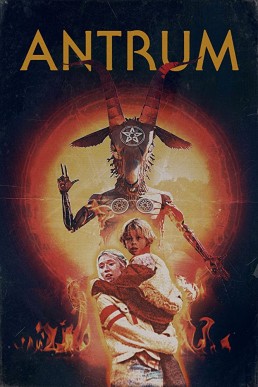
Antrum: The Deadliest Film Ever Made
Setting the hate aside for a second (I’ll pay it lip–sevice in a second), this is not a bad occult film at all, with some genuinely creepy stuff going on in it. I found myself in the same boat JJ described this past Halloween season, underwhelmed by the majority of options out there and mostly returning to classics, but this is one new(ish) title I stumbled across that suited the Halloween mood. A couple of kids go out into the woods and dig a hole looking for Hell and find it. They are beset by demonic presences and Satanists engaging in bestiality, necrophilia, cannibalism and other novel activities. the film is satisfactorily disturbing on the psychological side, relying on unsettling images and suggestions as opposed to an exploitative jumpscare/torture porn thing. Some parts are clearly derivative, pastiche, or knockoff, depending on how you look at it, taking cues from Blair Witch, Skinamarink, Texas Chainsaw and Wicker Man among others.
The film suffers from flaws aplenty, though they weren’t enough to kill the deal for me personally. It’s steeped in gimmickery, most prominently the whole “deadliest film ever made” thing. It’s presented as a 1970s low budget horror film that was lost and presumed destroyed, “until now,” and cursed in that whoever sees it will die. Hence the cinema in which the only screening occurred promptly burned in a fire killing all inside.
It’s off–putting, however, that all synopses and promotional material you’ll find are made with the intent of really fooling people into thinking it’s really a film from the 1970s. The syopsis on Prime video actually describes it as “A cursed film from the 1970s about a brother and sister who travel to a forest to dig a hole to Hell." The visual style as well is made to emulate 70s cinematography, editing and film grade such that it could fool anybody who didn't know better. So it’s been accused of going so far as to be guilty of false advertising.
The film also doesn’t seem confident enough either in itself or the audience. It’s peppered with subliminal images, some appearing as flashes of a few frames (evocative of Skinamarink), others as scratches on the film appearing as occult symbols, still others as subtle superimpositions. But rather than leave them subtle, frequent cues are included to draw the viewer’s attention to them, like, "see what we did, there?” For example one particularly gorgeous shot contains a demonic image in the frame that is hidden in plain view, quite masterfully. But then the shot is ruined when the demon intentionally nods its head as if to draw the viewer's attention to it, as though we couldn’t have noticed it on our own, or otherwise ben subliminally influenced by its presence. It’s a bit like when someone tells a joke and then says “get it?”
I decided to intentionally play along with the gimmickry, psyching myself into thinking maybe I really will die from watching the film (they really play up that aspect, even with a warning before the film starts, and a countdown representing the amount of time you have remaining to either leave the room or turn it off). It did add an extra level of willies for me. But even without that intentional participation, it’s still full of good creepiness.
I could nit–pick other details, like certain borrowed bits being a little too on–the nose (one bite from Blair Witch in particular is just too much to take entirely seriously), and the oft–committed cinematic crime of characters seeming to quickly recover from bullet wounds. But at least we might be able to imagine the explanation for that being that the characters are already in Hell.
Well I gave myself a time limit to complete this entry and as usual I’ve gone over it, so I have to end it in classic “gotta go” anticlimactic style. As I’ve indicated before I prefer to demure from star ratings, but I guess I could give this one… oh man, even with the egregious gimmickry I’ll be generous and say the accomplishments outweigh the failings. Seven willies out of ten.
Antraddendum:
I don't want to give the impression that it's a mere recycling of stolen bits. It bites certain riffs, but it brings plenty of novelty and originality to the table as well. It avoids numerous clichés to take its own direction rather than fall back on tired old themes, and it does go places most movies dare not go.
I neglected to mention that it's couched in a mockumentary about the film itself, so it's bookended by ostensible film historians and experts talking about the film. So don't be thrown by the beginning and think the whole thing is documentary–style. It's just part of the gimmick, building up the mystery and danger like a modern–day William Castle.
Again, I might be accused of not punishing the film hard enough for its shortcomings, but the totality of the overall effect and the satisfying aftertaste are enough for me to approve the pudding, even if a few corners were cut in the preparation process.
Last edited by Rampop II (11/16/2025 6:21 pm)
- Jinnistan
- Administrator
Offline
Re: Recently Seen
I liked Antrium, I think I also gave it a 7 or 7.5. And I definitely preferred the first half to the more grindcore attempt in the third act. I wish they would have taken a cue from some of the stranger '70s horror films, like Death Bed, and steered straight for the surrealistic ether.
- •
Thread Starter- Jinnistan
- Administrator
Offline
Re: Recently Seen

The new Cattet/Forzani film is equally rich in cinematic sugar as their previous work (Amer, The Strange Colour of Your Body's Tears, Let The Corpses Tan), and as those previous films were lovingly pastiches of Italian genre films, ranging from Bava to Leone, this film aims for the post-Bond era of stylish spy thrillers, especially Bava's Danger: Diabolik, while retaining a modern psychedelic sensibility. Basically the kinds of genre homages Tarantino could make if he wasn't such a self-absorbed jack-off.
This film involves some smuggled diamonds and an aged spy played by a resurrected Fabio Testi and a few leather-gimped assassins. I have to admit, I'm still not entirely sure what else actually happened, but I am sure that it was gloriously lensed.
8.5/10
This film, also gloriously lensed and a festival favorite this year, is simply too accomplished to dismiss. But unfortunately, for me, it's ultimately way too dismal for me to fully embrace. I saw one review which said that the film proves "the journey is better than the destination". Which seems like a roundabout way of rationalizing how the destination of this film happens to be so dismal. Otherwise I would agree. The film, overall, is a lot better than its resolution, but I can't entirely forgive its edgelord fatalism. That said, I wouldn't hesitate recommending it either.
7.5/10
- •
Thread Starter- Jinnistan
- Administrator
Offline
Re: Recently Seen

To play devil's advocate a bit, because generally my own politics largely align with director Raoul Peck's, one could make a sound argument that, by wearing his own politics so stubbornly on his sleeves here, Peck is in peril of crossing a certain ethical line, falling into a trap of the kind of pedantic polemic which Orwell himself universally skewered. I would add that this doc help's one's ability to make such a case as well, because all of Orwell's critical semiotic tools are so evidently demonstrated here, that I believe that anyone having watched this doc, regardless of politics, will walk away all the wiser and with sharpened skillsets in areas of media literacy and historical context. Sure, maybe I'd prefer a more Adam Curtis-style semiotic deconstruction type of doc, but that's just a different flavor of gravy.
8/10
- •
Thread Starter- Rampop II
- Member
Offline
Re: Recently Seen
I didn’t know raspberries grew in Thailand.
So, on the heels of my Sam Raimi and Muy Thai rewatches, and more than tired of the same old “rescue the damsel from the gangsters” plot line, I found myself considering the challenge of writing a plot for a martial arts movie set in modern times, with modern weaponry rendering martial arts all–but obsolete. During my contemplations, one of the options that came to mind involved potential dealings with the undead. Any kind of undead, be they regular old zombies, or something more specialized, like re–animated fighting badasses tasked with serving some conjurer or mad scientist, or maybe occultist mobsters even (I mostly left out vampires due to all their other abilities)… they mostly negate the need for guns and lend themselves to endless opportunities for squishy–bashy fun. It should be at least somewhat tongue–in–cheek, imo, if not a hell of a lot more than somewhat, seizing opportunities for the type of Raimi/Jackson humor that has apparently come to be known as “splatstick.”
So since I can’t possibly be the first to think of it, I googled it: any zombie martial arts movies out there? The search results yielded a couple of vintage titles like 1981’s Kung Fu Zombie, and, well, lookee here! A brand–new 2025 title from Thailand, Ziam, described as a Muy–Thai movie set in a hospital full of zombies! “Perfect!” I thought. Just what I was looking for. Ol’ Rampop's finger still has the touch for the pulse of the Zeitgeist. And it’s on Netflix! It had the look of a “serious” horror movie, no indication of it being a Muy–Thai Evil Dead II or anything, but all the same I couldn’t wait for the cable guy to fix my Internet so the first thing on my watchlist would be some Muy–Thai zombie mayhem. I mean, how can you go wrong with a concept like that… er, right?
I was still careful to temper my expectations, but nothing, noooo–thing could have prepared me for just how much Ziam sucks. I mean, it suuuuuucks! It’s barely a martial arts film at all, and what little fighting does happen is more, what would you call it? “Cam–fu?” Where the camera angles and editing seem to do most of the stage combat, seemingly covering for the fact that the actors can’t really fight. I got the sense the hero was played by a pretty boy instead of a real fighter, because a Tony Jaa movie this ain’t.
And I sensed right: lead man Prin Suparat is described as a “Thai actor and model,” as is his lady co–star Nuttanicha Dungwattanawanich. No mention of martial arts involvement in their bios whatsoever. So, a martial arts movie without martial artists. That’s downright insulting, to audiences as well as to the many hardworking actors with proven track records kicking ass for the screen, and bearing the scars to prove it.
Predictably, Ziam's characters are as interesting as a clothier’s catalog, and the movie is a drab mix of generic 28 Days–style “fast zombie” gore, and that weepy brand of Southeast Asian ultra–saccharine super–schmaltz that I have never, ever understood. That syrupy soft–focus sector of mainstream pop culture, characterized by one laboriously long tearstreaked romantic pop–ballad after another, a high–fructosity so pervasive and widely beloved by so many across multiple generations, that I have to shrug without even bothering to hate on it and simply accept that it’s something I just don’t get, but something of apparent value to someone... one of those incredible kicks I’ll never know. How it has any place in a gore flick, especially a “serious” one, I cannot understand …unless that romantic sweetness is the humor, just lost on me in translation; maybe the juxtaposition of saccharine pop–romance aesthetic against the backdrop of a dystopian zombie gorefest is the Thai version of a grimacing Ash clutching his decapitated Linda’s necklace in anguish, and as an outsider I just don’t realize it. To my eyes it looks more like the hallmark of executive interference. Someone upstairs didn’t trust the recipe, and the notion prevailed that a cheesy romance starring a couple of models was more likely to appeal to a mainstream audience and reap the returns. And since “returns" are measured by Netflix in terms of viewership, the question of whether or not 2025’s Ziam reaps enough to justify the $200 million(!) investment remains to be seen. Reviews meanwhile have apparently been inexplicably and sickeningly positive.
Regardless, one thing I can say with certainty is that as a martial arts film, Ziam is unequivocally not up–to par. As I said the camera does most of the work, with added help from the foley art, of course. Speaking personally, it's everything a martial arts zombie flick should not be, so much so that it gave me a flood of great ideas born from all the missed opportunities, the way awful movies can sometimes do. I mean, come on, Muy–Thai–plus–zombies is inherently outrageous. Attempting to make it “serious” is nearly an open invitation to ridicule.
Ziam even has a scene in the NICU… without any zombie babies! How do you pass on that opportunity??? Can you IMAGINE a sequence with martial arts fighters fending off a nursery’s worth of rabid zombie babies??? That shit would be hilarious!!! I hope we get to see that someday. Where else in cinema would it be acceptable for the hero to go full–powered black belt baby–bowling? When else would an audience howl in approval as a newborn is mercilessly drop–kicked into that huge plate glass window? Have you ever seen a crown–cracking Muy–Thai triple–combo unloaded on a bloodthirsty tot? Because I haven’t. But I now feel my life will be less–than complete if I never do.
I will grant a little corner of a “star" for a novel plot twist at the end that renders the zombies transformed into a toothy zombie/mutant monkfish hybrid. The result is a promisingly outrageous image that could have helped make for a more entertaining ride, but coming so close to the end it was barely capitalized upon, and became just one more example of what this drearily disappointing movie could have been.
Maybe I should take some steps to find out if Ziam played better among Thai audiences, but coming from Rampop personally, unless you have all the time on this Earth of the undead on your hands, or are just into agonizing boredom, Ziam is a stinker to be avoided.
- Jinnistan
- Administrator
Offline
Re: Recently Seen

Very admirable debut from Durga Chew-Bose, taking the daunting task of updating the 1958 classic film to more modern sensibilities, where certain scintillations such as a sexually flowering adolescent with a suggestively close relationship with her promiscuously libertine father might still arouse some inhibitions among today's audiences. But as the film lays out early on, "sexy" is not the same word as "beauty", and, handsomely aided by the gorgeous Mediterranean cinematogrpahy, all of this beauty is just a shell anyway. The theme of the completely unnecessary tragedy underlying the ennui of entitlement is summed up at one point: "This look on your face, like you believe nothing good has ever happened to you."
There's much talk about the weight of the young Lily McInerny stepping into the iconic role by Jean Seberg. I think we can all agree that Claes Bang is no David Niven. But most impressively is Chloe Sevigny capturing the somewhat thankless icy inferno which was Deborah Kerr.
8/10
This has an immediate sense of recalling the far superior Tar - laying out in its initial scenes a very defined sense of control, with its little 'tik-tok's on the soundtrack telegraphing calculation. Pretense abounds, and in Julia Roberts' Alma, a Yale philosophy professor, the whiff of her casually caustic chauvinism is clear. I have to try to manage my own preconceptions of some of this film's controversy, which I was already aware involves some scenario of predatorial manipulation, and, as Tar vaguely flirted with faux-woke provocations, this film seems destined to foreground those provocations. There's an awful early scene where the pretense becomes the text. We see these ivy league professors sitting around talking like dorm-mates with only the most banal type of academic discussion ("Nietzsche was a Nazi!"; "Freud was a misogynist!") which I can't imagine any educated professionals being the least bit inclined to discuss, except maybe as nostalgic deprecation. I was hoping this wasn't Amazon's way of conveying "intelligensia" to their dumbed-down audience.
I'll give the film the benefit of the doubt that this scene is serving to illustrate the ultimate mediocrity of some of its participants' wits. Michael Stuhlbarg provides a performance which seems to subtley undermine all of this. Most of the people here are simply not that smart, and rather than blame the script, I'll assume that's the whole point being exposed. But the film does begin to improve as the whole controversy part of the plot unravels, and we begin to see some actual humans in the characters rather than characters acting as avatars of identity politics. Interestingly, I notice that some of this film's critics dislike precisely these human complications which attempt to revise our reflexes, as if maybe they prefer the avatars instead. Like a lot of truly provocative films around our current social politics, people will molest it for whatever they can get out of it. I think that it is ultimately a cold, cynical film which has one really truly provocative scene which maybe could have made the foundation of a better film, where poetic understanding is explained and elevated above political understanding. But even that feels like weak Tar cosplay.
I like that this film is pissing a lot of people off. It's not a great film.
7/10
- •
Thread Starter- Jinnistan
- Administrator
Offline
Re: Recently Seen

Nicolas Ray's melodrama isn't nearly as sleazy as the poster suggests, and in fact it's a very interesting look at a woman with borderline personality disorder long before that was an acknowledged diagnosis. Joan Fontaine is luminous as seemingly naive Christabel with steep social ambitions and a tendency to achieve them off of the misfortunes she subtley causes to those in her immediate proximity. Fontaine is clever enough to never fully show her insidious side, though Robert Ryan, as a cynical author, is keen enough to suss out her latent duplicity.
Ray was a more mature filmmaker capable of avoiding the cliches of the genre, but the strongest element is a sharp script from Edith Sommer with lots of dishy dialogue, including giving Ryan a backhanded line which would put Rhett Butler to shame: "I love you so much... I wish I liked you."
8/10
It's easy enough to consign this to the era's plethora of James Bond imitations, even if aided by U.N.C.L.E. star Robert Vaughn, but more interestingly is that this film (written by MI6 agent Helen MacInnes) falls into that category of films which presciently alluded to the MK-Ultra program (along with Manchurian Candidate, Ipcress File) long before the public had any awareness of the existence of such a program. Vaughn helps significantly as well as a more sensitive ex-CIA officer caught in-between intelligence factions and his ex-lover (Elke Sommer) who happens to be a double agent herself. There's also a tremendous bench of supporting players, from Ed Asner (looking like Bob Hoskins), Boris Karloff and Karl Boehm as a particularly slithery spook. Also Luciana Paluzzi (Thunderball) has a funny but brief turn as an accomplice's secretary just to tie the Bond connection all together.
7.5/10
Richard Burton goes full Edgar G. Robinson as a vicious cockney crimelord, relishing the role in froth and fury. For a 1971 British film, this is probably second only to Get Carter in the extremity of its violence and language, and its homosexual subplot (inspired by the then-recent Kray Brothers arrest and convictions, and the revelations of their relationships stemming from that) is suprisingly frank for a period when, just the year prior, the subject was quite controversial in Performance (which incidentally was also inspired by the Krays). Besides Burton's bulldog swagger, Ian McShane is impressive as an opportunistic pimp, and the heist at the center of the film proves to be a thrilling demolition of unfortunate contingencies. Apparently the screenwriters, adapting the hardboiled source novel, were comedy writers, which makes some sense in hindsight.
8/10
- •
Thread StarterA lot of people don't realize what's really going on. They view life as a bunch of unconnected incidents and things. They don't realize that there's this lattice of coincidence that lays on top of everything. Give you an example; show you what I mean: suppose you're thinking about a plate of shrimp. Suddenly someone'll say, like, plate, or shrimp, or plate o' shrimp out of the blue, no explanation. No point in looking for one, either. It's all part of a cosmic unconciousness.
Everybody's into weirdness right here.